If you've ever sat through a Hanuman Chalisa path, you've said this line without really thinking about it: "Bestower of the eight Siddhis and nine Nidhis." It just comes out, almost automatically, and then everyone's already onto the next chaupai. But stop for a second. Do you actually know what these eight siddhis and nine nidhis are? Why does Hanuman Ji get the credit for handing them out? Worth slowing down on this one.
A siddhi is a spiritual power, something earned through years of tapasya and steady devotion. A nidhi is treasure, and not in a small way either; it's the kind of abundance that leaves nothing wanting. Put both together, and you get someone with full command over the supernatural and the material both. That's what tradition says about Hanuman Ji. The interesting part isn't that he has all this; it's how rarely he uses any of it for himself.
The wording shifts a bit between texts, but you'll usually find these eight:
● Anima – shrinking to the size of an atom
● Mahima – growing to an almost unimaginable size
● Garima – becoming infinitely heavy
● Laghima – becoming weightless
● Prapti – obtaining anything from anywhere
● Prakamya – having any wish granted instantly
● Ishitva – holding complete authority over all things
● Vashitva – influencing or controlling others
There's a good example sitting right in the Ramayana. When Hanuman Ji leapt across the ocean toward Lanka, his body grew massive enough to cover that distance, yet stayed light enough to move through the sky effortlessly. That's Mahima and Laghima, both at work, in one single moment.
Where siddhis are about power, nidhis are about wealth. They trace back to Kubera's treasury, and Hanuman Ji is said to hold the keys.
● Padma Nidhi – abundance like a lotus in bloom
● Mahapadma Nidhi – riches on a grand scale
● Nila Nidhi – wealth in precious gems
● Mukunda Nidhi – prosperity through grain and food
● Nanda Nidhi – a treasure that never runs dry
● Makara Nidhi – wealth tied to safety
● Kachchhapa Nidhi – slow, steady growth
● Kunda Nidhi – silver and similar metals
● Kharva Nidhi – abundance in daily needs
Read through that list slowly and you'll see it covers nearly every worry a household might have, food, safety, savings, stability. Not much left out.
None of this arrives out of nowhere. Every telling of it says these powers and treasures show up only after real discipline and years of devotion. They're a result of inner growth, not something chased for its own sake.
Notice the word the Chalisa uses, "data," the giver. Not the owner. Not the keeper. He doesn't hold onto any of it, he passes it along to whoever comes to him with genuine faith. This is probably why devotees rarely ask him directly for siddhis or riches. People ask for courage instead, trusting the rest will follow once that part is settled.
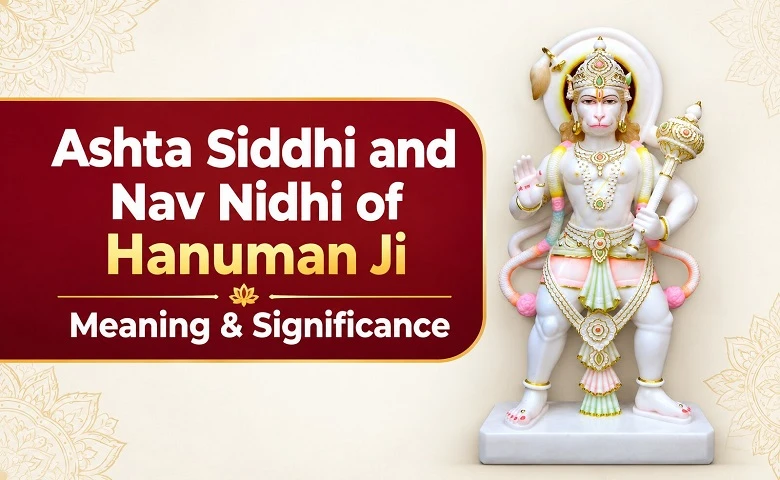
Next time you're at a Hanuman temple, actually look at the murti instead of walking past it. He's rarely just standing there. Usually he's mid-leap, or tearing open his chest to reveal Ram and Sita, or gripping his Gada like he's ready to act at any moment. Every pose has one common message: power that is disciplined and devoted entirely to service. This symbolism is often reflected in marble Hanuman murtis, where every pose captures Hanuman Ji's strength, devotion, and readiness to serve.
The line comes from the fourth chaupai: "Ashta siddhi nav nidhi ke daata, as var deen Janki maata." According to this verse, Mata Sita gave Hanuman Ji the power to grant all eight siddhis and nine nidhis to sincere devotees. Easy to chant past without noticing, but it holds the entire philosophy in one breath, devotion earns blessings, and blessings are meant to be shared.
This was never really about shrinking to the size of an atom or gaining a magical store of wealth.
● Restraint is its own kind of strength.
● Wealth or talent means little without humility.
● True growth comes through discipline, not shortcuts.
● Every gift is best used in service of others.
Most people who recite the Hanuman Chalisa aren't seeking supernatural powers. They simply want a little of Hanuman Ji's courage, strength, and devotion to get through the week.
Conclusion
Remove the mythology, and what's left is a lesson in character. Hanuman Ji isn't remembered for holding onto these gifts, he's remembered for giving them away and choosing service instead. That's likely the real message tucked inside those old Sanskrit names.