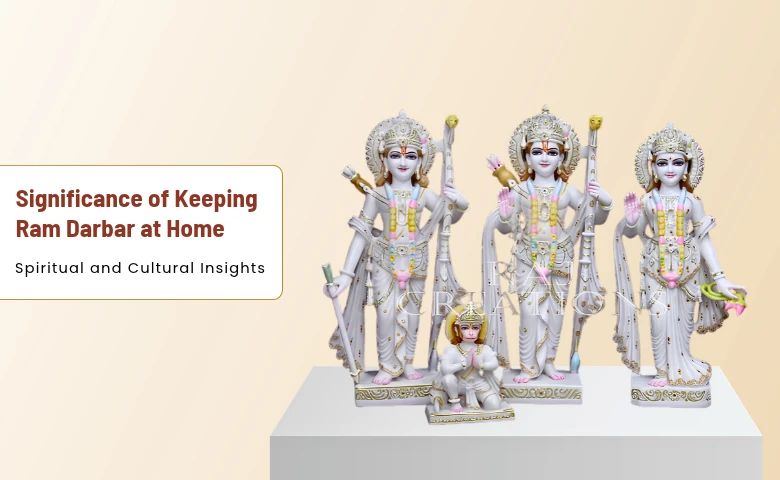
Maryada Purushottam Shri Ram is the epitome of grace, courage and integrity. Ram Darbar, the divine court of Lord Ram, symbolizes truth, morality, and peace. Keeping a Ram Darbar statue at home holds deep spiritual and cultural significance, which is why many devotees welcome it into their homes for its spiritual benefits.
In Hindu tradition, Ram Darbar is far more than a royal scene. The scene recalls the moment after Rama’s return to Ayodhya. Rama’s coronation marked the inception of Ram Rajya. The story appears in Valmiki’s Ramayana and Tulsidas’s Ramcharitmanas.
Many Hindus begin their day with prayers before the statue to find peace. The daily rituals include daily prayers, lighting a Diya, offering flowers, reading the verses, chanting divine names. A 3 feet white marble Ram Darbar murti is a very popular choice for homes, temples and spiritual places.
The Ram Darbar has many divine characters and each has a deep meaning.
He is the supreme practitioner of boundaries, ethics and virtue. As a king, Rama always put the welfare of the people before his own happiness. As a son, he sacrifices a kingdom to keep his father's word. His life therefore teaches sacrifice, compassion, and responsibility. The iconic bow in the murti stands for bravery.
Standing to the left of Ram is Goddess Sita’s murti. Sita has faced many hardships in her life. Still, she was firm in her principles. Even today, the story of Maa Sita inspires millions of Hindus. She is frequently connected with purity, passion, patience and unconditional love.
Lakshman lived and died in the service of Lord Ram. Even today, when people look for examples of true brotherhood, Ram and Lakshman are cited as the classic example. He encourages his followers to cherish loyalty, discipline, respect, and selflessness.
Hanuman showed extraordinary devotion to Lord Ram all his life despite possessing immense individual strength. In Hindu history, Hanuman is known for qualities like courage, protection and devotion.
Devotees worship the three divine personalities together in a Ram Darbar statue. Their story shows three souls bound by dharma, love, and sacrifice. A Ram Sita statue, with Ram symbolizing strength, Sita compassion, and Lakshman loyalty, brings complete blessings into one’s life, according to Vedic beliefs. When Rama was sent into exile for fourteen years, Sita chose to go with her husband. Lakshmana chose to follow his elder brother. They were not commanded to go, but both gave up palace comforts out of love and duty. That voluntary companionship is why the three are remembered together.
Also, in Yogic philosophy, the human mind is governed by three gunas. These are Sattva (purity), Rajas (activity), and Tamas (inertia). The Ram Darbar murti harmonizes these energies perfectly.
The benefits of keeping Ram Darbar at home are beyond measure:
To maximize the benefits of a marble Ram Darbar statue, choose the right placement. As per Vastu, the north-east corner of your house is the most auspicious direction for placing a Ram Darbar. If the northeast corner is unavailable, the second-best space is the absolute east or absolute north.
Avoid the southern part of the home, as it disturbs peaceful vibrations. Ideally, position the court, so the deities face west or east. This means you naturally face east or north whenever you sit down to pray.
Conclusion
The Ram Darbar statue embodies a lot more than a religious custom. It is a daily reminder of dharma, devotion, loyalty and selfless service. Devotees often turn to the Darbar in times of challenge to find strength and direction. Bring a Ram Darbar murti to your home to bring positivity and calmness in the ambiance inspired by the life of Shri Ram.